
ALLEVIATE TOGETHER.
RESEARCH PROJECTS.
KNOWLEDGE TRANSFER
THROUGHOUT EUROPE.
The European Tinnitus Network



Our vision
EUTINNET was founded in 2019 under the umbrella of the German Foundation Tinnitus & Hearing Charité. The network unites numerous European tinnitus self-help organisations and is in active exchange with leading ENT universities and research institutions in Europe.
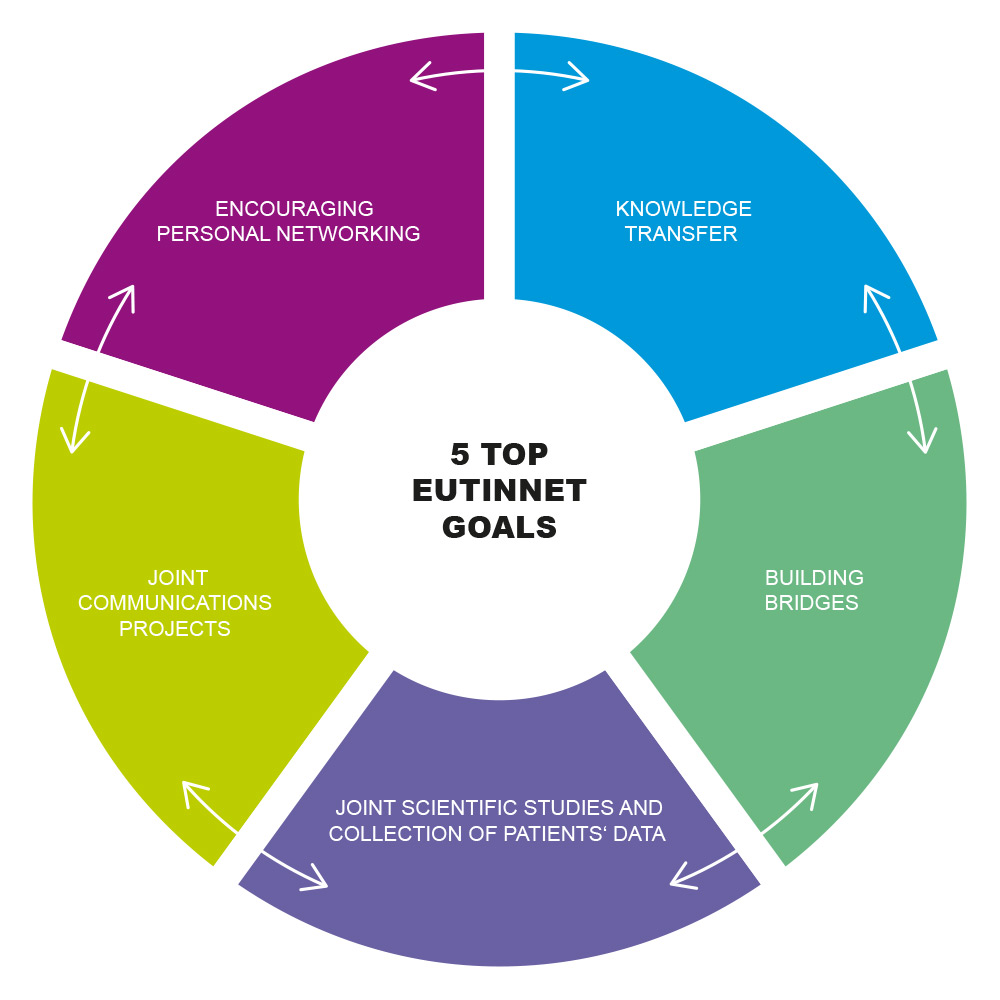
The common goal is to promote transfer of knowledge on treatment options for tinnitus and other hearing impairments in the member countries, to organise research projects and to create even more awareness for the careful handling of hearing through communication and education.
Please find detailed information on our goals in our information flyer:
The Top 5 EUTINNET Goals (PDF, 226 KB)
Scientific Council EUTINNET
Across Europe, millions of people suffer from chronic tinnitus or diseases of the inner ear, such as hearing loss, hyperacusis or Meniere’s disease. These can lead to a severe restriction of quality of life and performance in both the professional and private spheres.
The Scientific Council members provide strategic guidance for EUTINNET, drawing on their extensive expertise in ENT medicine, psychosomatics and psychology. They foster cross-European exchange and collaboration among scientists and self-help organisations and support the development and implementation of joint research initiatives.
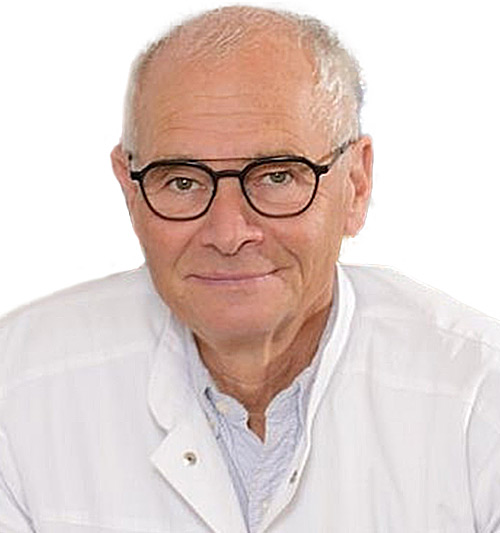
Dr. med. Eberhard Biesinger
Chairman EUTINNET Council
Otolaryngologist with expertise in chiropractic therapy at the ENT practice in Lindenberg and member of the Scientific Advisory Board, Foundation Tinnitus & Hearing Charité
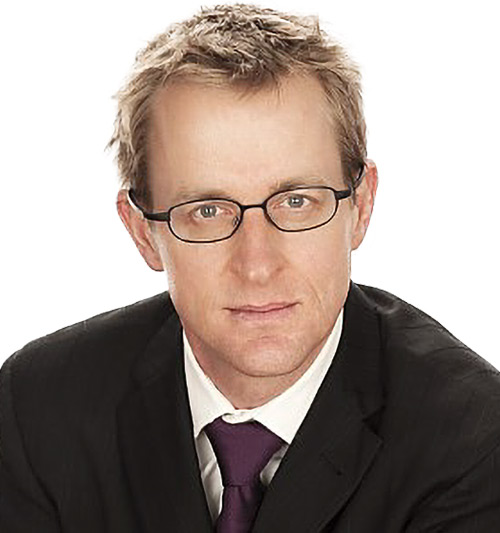
Prof. Dr. Christian Dobel
Deputy Chairman EUTINNET Council
Professor for Experimental ENT Science, ENT Clinic, Friedrich Schiller University Jena, Germany, and Chairman of the Scientific Advisory Board, Foundation Tinnitus & Hearing Charité

Prof. Dr. Birgit Mazurek
Member of the EUTINNET Council
Director Tinnituszentrum Charité – Universitätsmedizin Berlin, Germany, and Chairwoman of the Board, Tinnitus & Hearing Foundation Charité
Members
EUTINNET members
The network currently has 12 member organisations from Europe. Together they help to promote the exchange of experience and to advance research projects. New members are welcome.
For more information, please click on the respective logo.

United Kingdom

The Netherlands

The Netherlands

Switzerland

Germany

Austria

Belgium
France

Italy

Czech Republic

Denmark

Spain
Die EUTINNET-Studie
Über die webbasierte Erhebung von Patient:innendaten
Die vorliegende Studie soll Aufschluss über den Zusammenhang von Tinnitus, Hyperakusis und weiteren Komorbiditäten, wie Stress, Ängste und Depressionen geben. Dies geschieht durch Vergleichs-untersuchungen der über die beiden Tinnitus-Fragebögen und drei weitere Komorbiditäts-Fragebögen eingegebenen Daten von Betroffenen.
Langfristig gesehen ist eine longitudinale Datennachverfolgung zur Aufnahme weiterer Befragungsergebnisse in die Datenbank geplant.
The six questionnaires
Mit den soziodemographischen Fragen werden konkrete Merkmale zur Person abgefragt, die wichtig sind, um die wissenschaftliche Auswertung der darauffolgenden Befragungen zu Tinnitus, Hyperakusis sowie Stress, Ängste und Depressionen differenzierter vornehmen und die richtigen wissenschaftlichen Ergebnisse und Erkenntnisse pro Gruppe ableiten zu können.
Der Mini-Tinnitus-Fragebogen (Mini-TF12) gibt darüber Auskunft, mit welcher Intensität der Tinnitus Ihre Gefühle und Einstellungen beeinflusst.
Ziel des Tinnitus-Beeinträchtigungs-Fragebogens (TBF12) ist es, Ihnen als Betroffenen die Möglichkeit zu geben, konkrete Schwierigkeiten und Beeinträchtigungen anzugeben, die Sie auf Grund Ihrer Ohrgeräusche persönlich erleben.
Mit dem Mini-Geräusch-Empfindlichkeits-Fragebogen (Mini-HQ9) werden Beschwerden abgefragt, die Ihnen Außengeräusche jeglicher Art machen. Ziel ist es, herauszufinden, ob Ihre Geräuschüberempfindlichkeit Einflüsse auf Ihre Gefühle, Verhaltensweisen oder Einstellung haben.
Das Perceived Stress Questionnaire (PSQ9) dient dazu, Ihre subjektive Wahrnehmung, Bewertung und Weiterverarbeitung von Stressfaktoren festzustellen, denn das subjektive Belastungsempfinden ist mit ausschlaggebend für den Verlauf verschiedener Krankheiten und Störungsbilder.
Schließlich erfasst der Hospital Anxiety and Depression Scale (HADS) verschiedene Ängste und Depression bei Patient*innen mit körperlichen Erkrankungen oder (möglicherweise psychogenen) Körperbeschwerden.
Who is the study aimed at?
The survey is aimed at people in Europe who suffer from tinnitus and/or hyperacusis and who are willing to provide information about related concomitant diseases and impairments as part of a Europe-wide survey.
Why is your participation important?
The more people participate in the Europe-wide study, the more data can be collected and analysed by the EUTINNET Scientific Board. The results should provide new insights to improve diagnostic possibilities as well as therapeutic and medical treatment options.

Bei Fragen zu der europaweiten Datenerhebung im Rahmen der vorliegenden Studie wenden Sie sich gern an:
Dr. med. Eberhard Biesinger, Facharzt für HNO-Heilkunde, Koordination EUTINNET
E-Mail: info@eutinnet.org
News

EUTINNET supports the development of european Tinnitus Guidelines
The core objectives of EUTINNET include fostering knowledge transfer on treatment options for tinnitus and other hearing impairments within member countries, organizing research initiatives and studies, and collaboratively raising awareness about the importance of mindful hearing care through education and communication efforts. In line with these efforts, EUTINNET actively supports the development and application of tinnitus guidelines which focus on improving patient care.
One such guideline, the “European Guideline for Tinnitus,” was last published in 2019 and provides a standardized framework for the assessment and treatment of adult patients with subjective tinnitus. It aims to establish uniformity in clinical practices, optimize referral paths, and minimize over- or under-treatment of patients. Developed by a multidisciplinary group of academic authors from across Europe, the guideline also includes clear clinical definitions and patient profiling standards, serving as a vital tool to support shared decision-making and individualized care.
Currently, this guideline is being revised, a process led by Rilana Cima, Associate Professor at Maastricht University, Netherlands, and KU Leuven, Belgium. This update follows a structured, evidence-based methodology to ensure consistency, transparency, and reproducibility across all treatment sections. The authors of this review process have graciously invited members of EUTINNET to contribute by reviewing draft versions and/or actively participating in meetings, highlighting the organization’s commitment to collaboration and the advancement of tinnitus care standards.
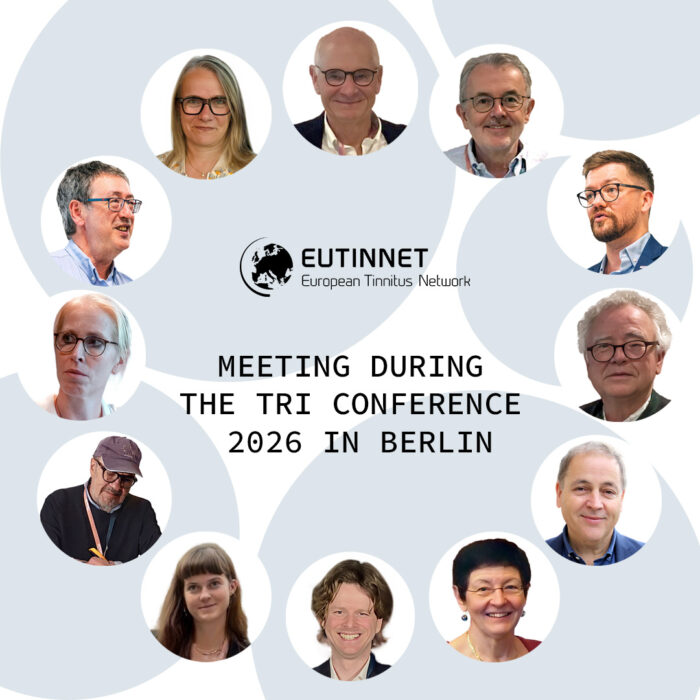
EUTINNET strengthens exchange and collaboration
We were very pleased to have the opportunity for a personal exchange with several EUTINNET members during the TRI Conference in Berlin – even though, unfortunately, the extensive and diverse scientific programme left us with only limited time for this and not all could join in. This meeting once again demonstrated the value of networking within EUTINNET and the many opportunities for further collaboration – both in terms of sharing experiences and knowledge in the field of tinnitus self-help and exploring potential future research, communication and awareness projects.
We look forward to discussing the next steps with all EUTINNET members at the next EUTINNET meeting in a few weeks’ time. You can find updates on this in the news section of the EUITNNET website as well as on the social media profiles of the respective member organisations.
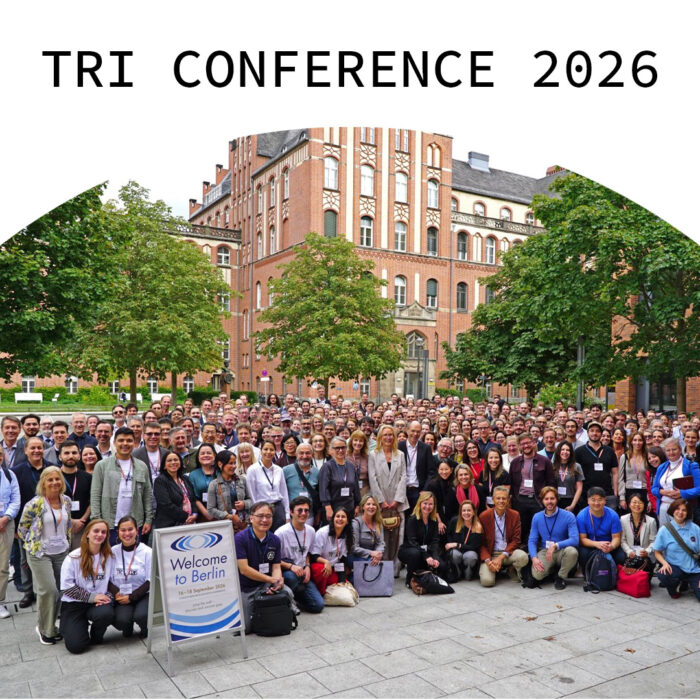
TRI Conference 2026 in Berlin
Celebrating its 20th anniversary, the Tinnitus Research Initiative (TRI) hosted the annual International TRI Conference in Berlin. Under the motto “Jump the wall – discover and uncover gaps,” chosen by the Congress Scientific Committee led by Prof. Dr. med. Birgit Mazurek and Prof. Dr. Berthold Langguth, the event focused on interdisciplinary collaboration to advance tinnitus research and treatment. Tinnitus, a multifaceted condition affecting millions globally, often involves challenging comorbidities.
This year’s conference, co-organized by the Tinnitus Centre Charité and the Foundation Tinnitus & Hearing Charité, welcomed over 300 clinicians and researchers, including many from across the European continent. Representing fields such as otology, neurology, neurosurgery, psychology, bioinformatics, basic research and self-help, participants shared expertise and explored innovative approaches to develop effective diagnostics and therapies. The event also encouraged early-career researchers to engage with leading experts.
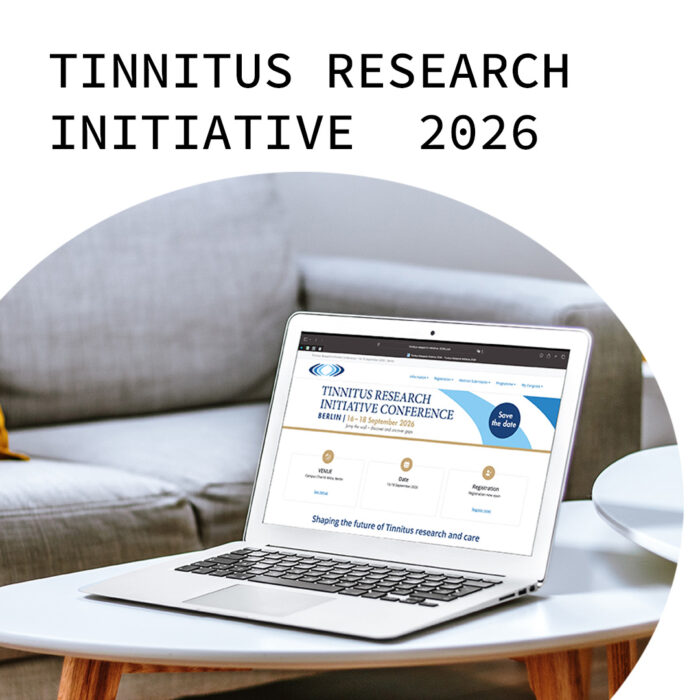
Berlin, 16–18 September 2026: 20th Tinnitus Research Initiative (TRI) Conference
We are pleased to announce the 20th Tinnitus Research Initiative (TRI) Conference 2026. The Tinnitus Centre at Charité – Universitätsmedizin Berlin and the German Tinnitus & Hearing Foundation Charité are jointly organising this international conference, which will take place in Berlin from 16 to 18 September 2026.
Hundreds of leading tinnitus experts from around the world will come together at the Charité Campus Mitte in Berlin to share the latest findings in tinnitus research, diagnosis and treatment, as well as in the management of associated conditions. The interdisciplinary exchange between ENT specialists, neurologists, audiologists and psychologists aims to deepen our understanding of how tinnitus develops, improve symptom management and ultimately pave the way towards a cure. The conference is scientifically led by Professor Birgit Mazurek and Professor Berthold Langguth. Experts and interested participants from Europe and around the world are invited to register online.
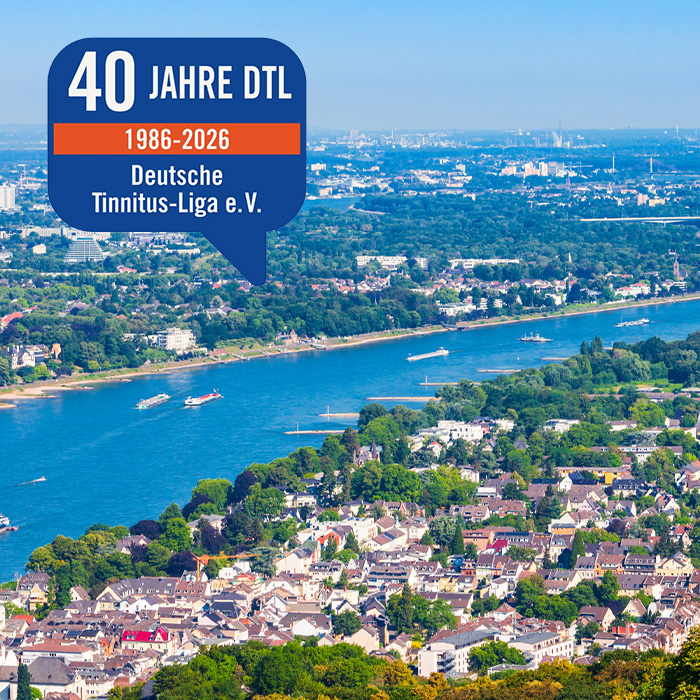
40 Years of the German Tinnitus League
The German Tinnitus League (Deutsche Tinnitus-Liga e. V.) celebrated its 40th anniversary with a varied programme of expert presentations, personal reflections and opportunities for discussion and exchange. Around 80 guests came together to learn about tinnitus, hearing loss, Ménière’s disease, mental wellbeing and current developments in tinnitus research. International collaboration with the Tinnitus Leagues in Austria and Switzerland was also an integral part of the programme.
Speakers included Dr Frank Matthias Rudolph, who gave a presentation on tinnitus and hearing loss; Dr Helmut Schaaf, who provided fascinating insights into Ménière’s disease; and Dipl.-Psych. Mykola Fink, who explored the topic of mental wellbeing. Professor Birgit Mazurek also contributed a lecture on the current state of tinnitus research. Alongside the expert presentations, Professor Gerhard Goebel offered a moving look back at four decades of DTL history, while Dr Roland Moschen from the Austrian Tinnitus League and Rainer H. Porschien from the Swiss Tinnitus League shared insights into the work of their respective organisations. Another highlight was the introduction of the new Executive Board: Bernd Strohschein was re-elected as Chair, Fred Podszus remains Treasurer, and Markus Hahn joins the board as Deputy Chair. Congratulations!
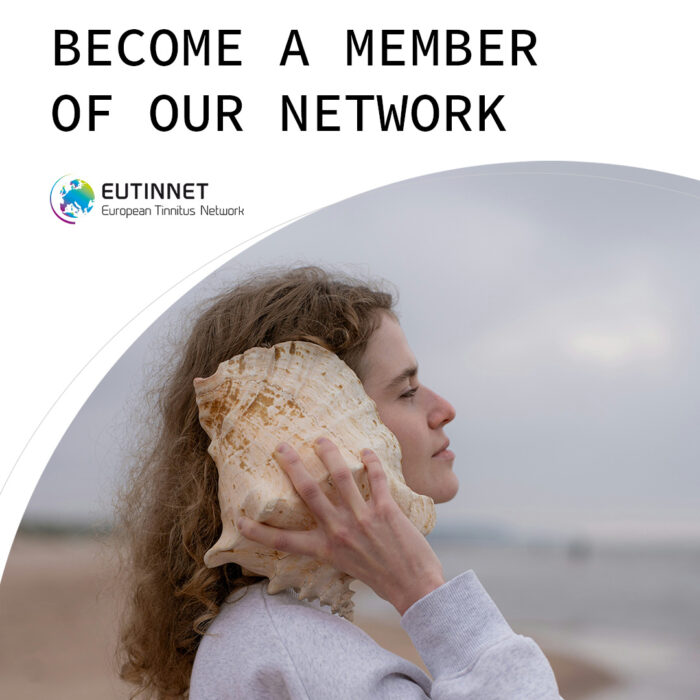
Welcome to EUTINNET, the European Tinnitus Network
As a member, you are part of a diverse community of tinnitus and hearing impairment organisations from across Europe, all committed to raising awareness, sharing research findings and supporting people affected by tinnitus and related conditions.
By connecting with experts, researchers and patient organisations, you help contribute to improving treatment options and fostering collaboration across borders. Your involvement helps strengthen the network’s mission, promote knowledge transfer and improve the quality of life of people living with tinnitus.
Unsere News auf Social Media:
Interessante Neuigkeiten aus dem EUTINNET-Netzwerk, Termine sowie weitere Highlights zu den Themen Tinnitus, Hören, Hörbeeinträchtigungen sowie Diagnose- und Behandlungsmethoden posten wir regemäßig auf den Social Media-Kanälen der Stiftung Tinnitus und Hören Charité:


